
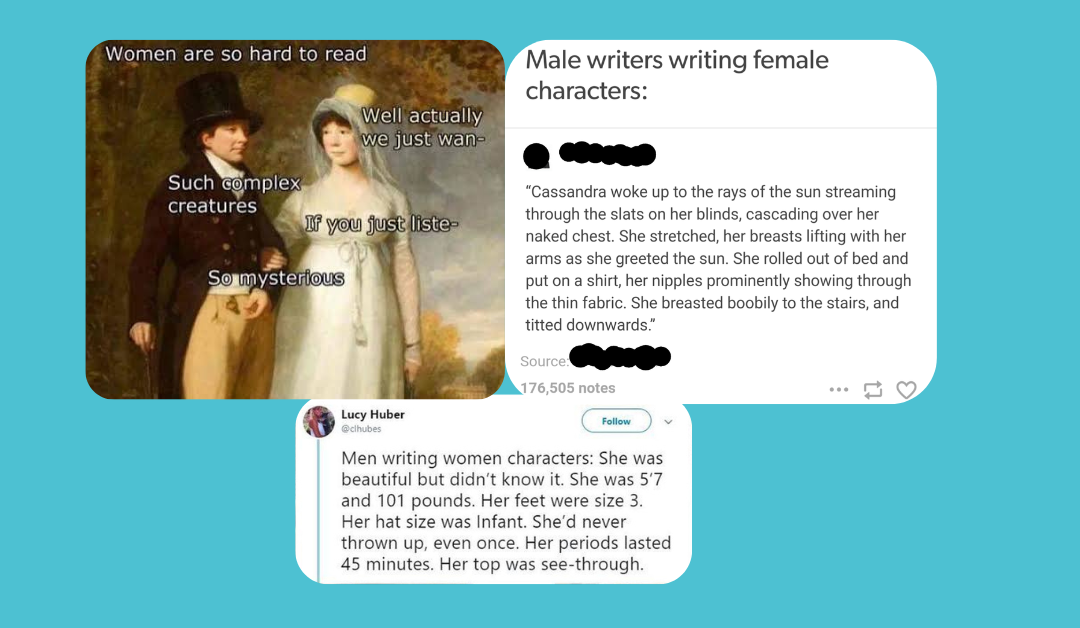
Yes, it’s a cliché…but isn’t that because it’s mostly true?
There’s a literary joke so well-established we barely even need to explain for everyone to get it. You’ll have seen the memes. If you’ve been around the bookish internet for a while you’ve probably encountered the r/menwritingwomen subreddit where the examples from traditionally published books and other written and visual media are stacked and saved, an ever more teetering pile of evidence that men just can’t write convincing women characters!
At least not without making them into an assortment of walking breasts, pretty little idiots, pick-mes with a great line in catty remarks, or supposedly formidable senior professionals who crumble as soon as the plot needs the man to take over. Isn’t that so funny?
And it is a joke. In the you-might-as-well-laugh-as-cry-again vein.
Anyway, you know exactly the writing I’m talking about and probably a few examples from books, films and TV have swiftly come to mind, so let me explain what I’m really talking about.
Although this looks like a problem with men writing women, I think it’s really a problem with POV – point of view – and with writers who don’t understand that POV isn’t cosmetic, but cognitive.
I don’t think the problem here is that men can’t write women because they don’t know how women think or even that they think, because plenty of women can’t write women either.
I think the problem is that some writers can’t write convincing people because they can only really write versions of themselves. They aren’t good enough at imagining what it is to be another type of person who isn’t just like them. Their point of view is too limited to produce characters that are more than a superficial collage of exterior signals, with the barest or no nod to their interiority.
What does ‘writing a woman’ actually mean?
We’ll stick with talking about writing women because it provides such clear ways to show how not to write a character.
In fiction, point of view (POV) is not simply the choice of first or third person; it is the particular way a character perceives, interprets and experiences reality.
A poorly written woman could comprise several technically correct descriptors and labels – she wears clothes that fit; has personality traits as described by her actions, other characters or the author; has relationships with other named women and conversations with them that aren’t about men; she has a menstrual cycle if relevant; and generally she behaves in ways that are coded ‘feminine’ – and still she feels fundamentally unreal.
Like an influencer or a pop star – if she does a good enough job of seeming authentic so that her fans can pretend they know her, maybe no one will notice for more than the briefest and occasional moment that they only see the highly curated and created version of herself and the reality is likely to be completely different.
But writing a convincing character isn’t about curating facts about their demographic. Those are labels, not characterisation. Characterisation is also not how mysterious or magnetic she seems, or how she makes a male character weave a whole cloth fantasy about her based on how the concocted version of her makes him feel about himself.
Characterisation comes from imagining what’s going on inside a person’s head: a person will notice some things and ignore others, make judgements about other people and themselves, feel embarrassed or proud or disgusted about some things, not even register things they don’t feel comfortable with or don’t want to admit to themselves. That interiority will then inform their actions, and as a well-written character will show strong coherence between their interior and exterior lives, such a character will therefore appear truthful to the reader.
That’s what I mean about POV being cognitive, not cosmetic.
Why POV is more than cosmetic
The ‘catty woman’ problem
Where men writing women come in for particular criticism is when their assumptions about women’s interior lives are so off the wall that it makes the reader lose trust in them as a writer. An example is the assumption that some women characters spend all their time evaluating and finding fault with other women: who dresses badly, who’s flirting obviously, who looks old, who’s trying too hard and needs to be put in their place.
I’m not saying women don’t look at and evaluate and think mean things about other people, but there’s a difference between being socially observant and having the entirety of one’s thought process taken up with mean-girl judginess.
It’s a missed opportunity: a character who is shown observing the interplay between other people and the social undercurrents around her will probably also have the depth to be thinking about several other topics. She could at another time in the story consider the things she said that she now wishes she hadn’t, or her fears of becoming like her father, or how her protected view of a beloved friend has blinded her to their terrible behaviour towards others – or just something interesting she saw on the train that made her think about another relevant thing.
What I’m getting at is that such a person will have more than one category of thought.
I get that dramatically it’s so tempting to make such a ‘baddie’ character really straightforward and simple, but then – and it was easy to miss if you didn’t care to look too closely – there were moments when even Regina George and Heather Chandler were implied to have more depth to their character than basic queen bee bitch.
The ‘beautiful heroine’ problem
The women characters who matter in fiction so often seem to be beautiful, striking, or sexy, and of course petite – and not just slim, they are tiny.
Where are all the simply ordinary-looking women who aren’t simultaneously the comic relief, or the main character’s sidekick, or someone’s mother, or some ghastly Shallow Hal-esque lesson in why you mustn’t judge people by appearances?
If women are to be written about as a population of human beings, then surely a few more of them could be unremarkable looking.
If the author signals the importance of a character by reference to how good-looking (or otherwise) they are, the reader is not invited to know that character but to look at her.
Much of the criticism of men writing women comes down to this overwhelming preference for presenting women as objects to look at, but the indoctrination into how to please the male gaze is so thorough that women writers do this too.
Sometimes it’s a kind of double-bluff where the main character will assure the reader she is very plain, but the behaviour of other characters will make clear that that is merely her modesty talking and actually she’s that dreadful male gazey paradox of a woman who doesn’t know she’s beautiful (and that’s what makes her beautiful). So she’s a beautiful woman with a thoroughly inaccurate self-concept and few observational skills, which coincidentally will explain why she’s terribly grateful to be loved by any mediocre man who clumsily courts her.
Again, I’m not saying there aren’t genuinely beautiful women whose insecurities are so overwhelming they cannot accurately see themselves. The point is there are plenty of people whose looks simply don’t come into whether they are interesting or real human beings worth writing about because they are neither especially beautiful nor plain – they’re just ordinary, normal-looking people.
The breasts!
And it’s not that talking about the physical aspects of a character is wrong – good writing well uses embodied characters – but again, it’s where the assumptions have taken over that the criticism is aimed.
Women don’t spend all their time thinking about their breasts, fellas. We know you think you would if you had them, but the truth is they just aren’t top of mind much of the time.
The fact is, the size and shape of our breasts don’t actually say anything about our characters, so it’s weird and insulting when a writer mistakes talking about a character’s body for talking about her character.
Why does this happen?
Writers – women and men – make a mistake when they default to their assumptions about other people, rather than leaning on their own observational skills.
There’s a very strong cultural message that feminine things are less serious, less important, and less worthy of attention. Boys and girls encounter these messages early. When very young a boy can learn that there are certain things he may not innocently like or pay attention to without being thought ‘girly’ and that having that judgement attached to him could be at least embarrassing for him and at worst extremely dangerous for him.
If a writer spends his life receiving this message that things coded ‘feminine’ are frivolous and beneath him, it’s understandable that writer may have a blind spot when he tries to consider female interiority, and feel enormous resistance to approaching, with genuine curiosity, observing women and the things they are allowed to like.
Hence, you get men writing these bonkers versions of women that no actual woman recognises, or not even trying to make the women characters anything more than paper-thin, or making the woman characters basically a man with breasts bolted on the front.
Understandable, yes, but it’s an explanation, not an excuse, and it’s not confined to men – women have their own social conditioning to unlearn. Writers of all sexes should interrogate their prejudices and work hard to portray humanity and the human condition truthfully.
Why Point of View matters in literary or upmarket fiction
I wonder if the greater education and sophistication of today’s readers (especially women readers in the last decades since we have been allowed to have degrees and jobs and our own bank accounts) and wider recognition and deconstruction of patriarchal thinking and conditioning means that what has historically been thought of as ‘literary’ writing may be changing.
Men have historically been given enormous licence in literary fiction to pronounce on women, sex, relationships, the world and human nature, but it’s hardly new to point out that some of the male literary canon features alongside beautiful prose some pretty unconvincing women characters.
And if literary fiction and upmarket fiction is characterised by its interest in human complexity and the human condition, then it’s probably quite important for its writers to be able to write human beings that readers recognise and believe in.
Writers cannot demonstrate their insight into humanity by only being able to show understanding of humans that look like and think like themselves. Beautiful prose is not the same thing as insight into people, and I think there are lots of readers who are no longer willing to mistake the former for including the latter.
It’s not ‘haha, men can’t write women without getting it embarrassingly wrong’, because women can write characters badly too.
It’s that writers should write about people different from themselves, and when they do, they need to watch out for the assumptions and failures of imagination that render their characters thin and unbelievable.
How to Write Better Female Characters: interrogate thought patterns, not just behaviour
If you’re writing a woman, you don’t start by asking yourself what women do or even what a woman would do. Ask yourself what this woman is thinking, and so what she would do.
If she says something, is it something she would say or just something someone has to say to move things along? Does it reflect what she thinks is happening in that conversation? Is she leaving something out, or getting something wrong, or maybe just half-right? Has she failed to notice something important that the reader needs to notice? Who does she take seriously and why? What is happening in her relationships with the other characters?
Then, if she does something, does it follow that this woman who said this thing will do this action? If it seems unexpected, is it actually a contradiction, or does it make sense for that character to do that unexpected thing?
A simple POV test – could this character exist without the male gaze?
If you take out all the men around her and her relationships with them, is there still a character there? One you can describe in detail? One who hasn’t just replaced her centre of the universe with ‘women’ or ‘children’ instead of ‘men’? Basically, does she have a life and a personality?
Will your readers also be able to answer what the women characters think about if you strip away the men around them? Have you given them enough evidence that they could answer questions like:
- What does she think about when there are no men around?
- What’s really important to her?
- What does she think she’s great at?
- What does she know she needs to do better?
If the character you have created is a person, there will be full answers to these questions. Not kneejerk, thought-terminating clichés, but full sentences.
POV Isn’t Cosmetic. It’s Cognitive.
POV isn’t labels and descriptors. POV is the way a particular person experiences reality.
This is true whoever the writer is, and however you could describe the character.
When a writer understands their character’s POV and has successfully translated it to the page, the reader feels like they’ve met that character and understands how the world looks from inside that character’s head – even if they never ever met someone like that, or if they’ve met dozens of people with similar traits.
It isn’t that men need to learn how women behave and think so they can write better women characters. Writers need to stop treating characters as functions of their category and start treating them as people.
The truth is, some writers haven’t learned to write people yet, and if they learn, their books will be a lot better.
Do the characters in your manuscript feel like real people yet? A professional manuscript assessment can help you discover the flaws holding your work back.


